 Jobs
Jobs Morita Farm Watermelon Work (2026)
Mt. Bijyo is one of Noto's most well-known mountains. Our farm is located at the top of the Bijyo mountain range. The soil is hard and coarse red soil; we work hard to grow watermelons in a place that is not easy to grow vegetables. However there is a reason why we continue to operate here. The red clay of Noto contains more minerals than sandy soil. Also, in the mountains of Noto, there is a difference in temperature between day and night, and the air is clean. The sunshine hours are also long in summer, which is perfect for growing sweet, crispy watermelons.
Agricultural work in general, not just watermelon cultivation, is hard work. At Morita Farm, we think about how to reduce the stress of the people who work here, for example shortening working hours and introducing work machinery. And it's not just workers who can feel stress. Vegetables and fruit can also become stressed. Regardless of the weather, every day we check the condition of the flowers and fruits, and we only handle the plants when they want to be touched. By doing so, we try not to stress the watermelons. There are no years with the same climate. If you do the exact same thing as last year, the watermelons will not grow deliciously. Every year, we approach our work as if we are just starting out. In order to grow delicious watermelons, we believe it is important that both the workers and the watermelons feel no stress.
Watermelon seedlings are planted from early to mid-April, and the harvest is completed in mid-August. We only grow watermelons once a year, so the fields are only used during these four months. In the past, after harvesting the watermelons we used to grow radishes in the same fields. At first, we were able to harvest both watermelons and radishes of good quality, but the quality deteriorated year by year. The soil had weakened due to overuse of the field. Since then, we have been working exclusively on watermelon cultivation, spending time on cultivating the soil in the field outside of the cultivation period. Clean up is done quickly after the harvest is over, and in early autumn chicken manure and rice husks are spread over the entire field. It's then plowed many times, softening and mixing the hard red soil until spring so that good microorganisms can grow easily. The soil of Morita Farm is red soil, which is excellent at accumulating nutrients and has a high ability to supply nutrients to the watermelons. It's disadvantage is that the risk of disease is high due to poor drainage. Watermelons can catch many diseases, such as anthracnose, vine wilt, blight and sclerotia. Such pathogenic bacteria belong to the same family as mold. We disinfect regularly to prevent the spread of disease, but we believe that in order to further prevent disease, we need to grow microorganisms (good bacteria) in the soil before disinfection to get rid of the pathogenic bacteria. By growing microorganisms in the soil, soil damage and roundworms can be prevented safely and with care for the farmland without using soil disinfectants such as chloropicrin, which are classified as pesticide deleterious substances. There is a saying in Noto: "The people and even the soil are gentle". As the saying suggests, we are working on watermelon cultivation with the intention of creating gentle soil and caring for the land.
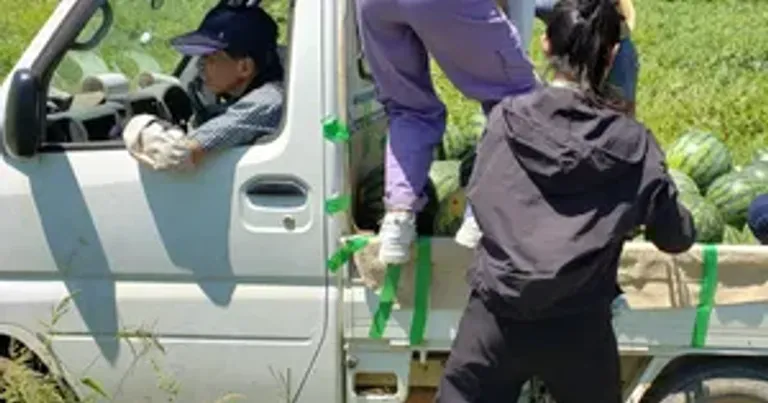
outdoor work1
Kanazawa is a tourist destination in Ishikawa Prefecture. Tourists from various countries visit Kanazawa. In the summer, many tourists eat watermelon as a dessert. We often hear the phrase, "Japanese watermelon is delicious." Various Japanese seedling producers are researching and testing repeatedly to create new watermelon varieties. When apples and pears are sold in stores, the variety is displayed. However, we have almost never seen watermelon varieties, such as "Harusoseki" and "Matsuribayashi", displayed in stores. Recently, we have begun to come across the "Raoh" series, developed for sweetness by Nanto Seed. Just as apples and pears have characteristics depending on their varieties, watermelons also have characteristics depending on the seed manufacturer and variety. We choose varieties by considering the balance between the sugar content, texture when eaten, and the beauty of the red color when cut. Recently, we often see cut watermelons labeled with a sugar content label, and we sometimes see sugar content labels that are not so high. Watermelon variety alone does not affect sugar content, nor does it add texture. The selection of varieties is just the starting point; the pursuit of sugar content and texture is in the cultivation method after that. Rather than cultivating watermelons that sell for tens of thousands of yen each, or watermelons that win prizes at competitions, we endeavour to provide reasonably-priced watermelons with uniquely well-balanced sweetness and texture.
Please log in to apply for this job
Copyright © YOU-I Group All Rights Reserved